Thirty Seconds to Judge a Record Shop: A Crate-Digging Guide for Your Own Town
Record digging in your own town is not a hobby. It is a test of patience, a refusal to let an algorithm choose your next favourite album, and a reasonable excuse to spend Saturday morning in a church hall that smells of instant coffee and old cardboard.
In 2026, Discogs will still have almost everything. eBay will still have the rare stuff, usually graded generously and priced optimistically. But the £3 copy of a record you did not know you needed is still sitting in a charity shop back room, behind a box of Danielle Steel paperbacks and a broken foot spa. You just have to know where to look, what to pay and when to walk away.
The thirty-second shop test
You can judge a record shop before you reach the crates. Give it thirty seconds. Here is what to look for.
- The window. If the window has been the same since 2019, with a faded poster for a tribute band and a hand-written 'We Buy Vinyl' sign, go in. If the window is full of Funko Pops and neon signs saying 'Good Vibes Only', lower your expectations.
- The smell. Old records smell of cardboard, dust and slightly damp sleeves. That is fine. If the shop smells of scented candles, it is a gift shop with a record corner.
- The staff. If the person behind the counter is reading a book, eating a sandwich or arguing with a mate about the second side of 'Rumours', you are in the right place. If they ask if you need help with anything before you have made eye contact, it is a lifestyle shop.
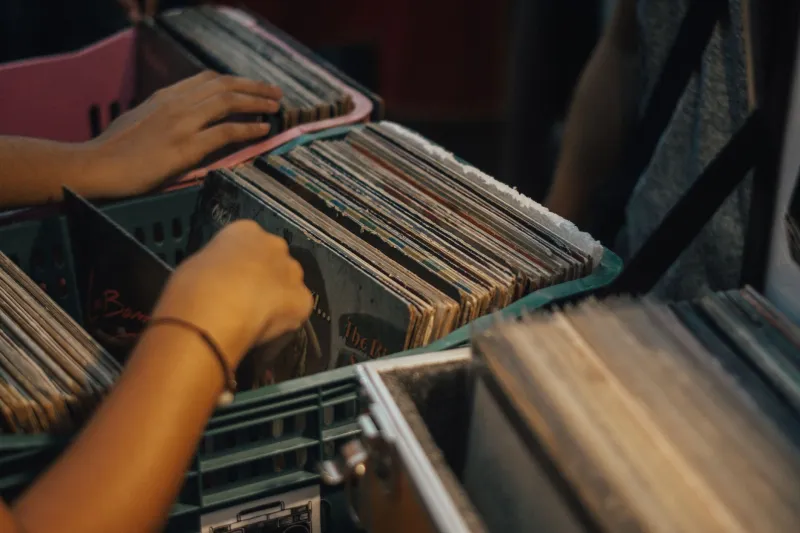
- The crates. Good crates are beat-up. They have handwritten dividers. They are not arranged by colour. If everything is sorted alphabetically and shrink-wrapped, you are paying for someone else's sorting, not your own digging.
- The price stickers. A good shop uses biro on a paper circle. A bad shop uses printed labels with the words 'collector's item' and no actual grade.
If a shop fails three of these tests, walk. There are better crates in the church hall.
Charity shops: go in with a plan
Charity shops are the most honest form of record digging. They are not trying to be cool. They are trying to raise money for a hospice, and someone has donated a carrier bag of records that was last opened in 1987. This is where you find the good stuff.
Go early in the week. Monday morning is good because people donate over the weekend. Ask politely if they have any records in the back. Do not be a nuisance about it. If they say no, buy a paperback and leave. If they say yes, be ready to look through a box that has not been sorted and is covered in a fine layer of dust. That dust is the point.
The records are usually priced at 50p, £1 or £2. Some shops have wised up and put the good stuff on eBay. That is fine. You are not looking for the good stuff. You are looking for the strange stuff: a 1970s folk album with a sleeve that looks like a woodchip wallpaper sample, a compilation called 'Hot Hits 12', a single by a band from the next town over that lasted eighteen months. These are the records that make the trip worthwhile.
Church hall fairs and the £1 box
Church hall record fairs are the opposite of a record shop. They are usually held on a Saturday morning, they usually have a trestle table with a tea urn, and they usually have a man called Dave who knows exactly what everything is worth and is not afraid to tell you.
Go in the first hour. The good stuff goes early. Take cash. Talk to the sellers. Ask them what they have been playing lately. You will learn more from a ten-minute conversation than from an hour of scrolling. And always check the £1 box. The £1 box is where the interesting records end up, not because they are bad, but because they are hard to price. A £1 box is a lucky dip with a soundtrack.
What to pay (and when to walk)
A rough guide for 2026. Charity shop: 50p to £3. That is the sweet spot. If they want £8 for a battered copy of 'Bat Out of Hell', leave it. Church hall fair: £1 to £5 for common records, £10 to £15 for something genuinely interesting. Independent shop: £5 to £15 for a clean, common record. More than that and you are paying for the shop's rent, not the record.
Walk away if the vinyl looks like it has been used as a frisbee. Walk away if the sleeve is held together by tape and hope. Walk away if the seller says 'it plays fine' but will not let you see the record. Walk away if the price is written in chalk on the window and the number has three digits.
Why local beats scrolling
Online record shopping is convenient. It is also boring. You type a title, you compare prices, you read a grading, you wait for postage. The algorithm learns what you like and gives you more of the same. A local crate is the opposite. It is a random selection of records that someone else could not sell, donated by someone who has moved house, priced by someone who is not sure what they have. That randomness is the whole point.
You will find things you did not know you wanted. You will buy a record because the sleeve is funny. You will take a punt on a 50p single because the label is a colour you like. You will get home, play it, and either love it or use it as a coaster. Either way, you have spent less than a cinema ticket and you have a story.
So check the charity shop back room. Go to the church hall fair. Judge the shop in thirty seconds. Pay £3 for something that might be gold. And if it is not gold, at least you got out of the house.