The Tie-Breaker Is Always About Trains: Inside the Tuesday Quiz That Holds a Town Together
Tuesday, 8.02pm, and the back room of the pub smells of radiator dust, lemon-scented surface cleaner and the faint ghost of Sunday lunch. Six tables, maybe forty people, and a stack of answer sheets held together with a bulldog clip that has seen things. Nobody is here for the prizes. The prizes are a box of Celebrations and a voucher for a carvery that expires in three weeks. People are here because it is Tuesday, and Tuesday has a shape.
The quiz starts late, as all good quizzes do. The landlord, Alan, has been threatening to start at eight sharp since roughly 2011. He has never once managed it. By twenty past, the teams have settled: the nurses off shift, the two blokes from the garage who write their answers in pencil, a table of sixth-formers who are inexplicably brilliant on the 1990s, and the couple at the back who never speak and always come second. There is also a team called Quizteam Aguilera, which is the sort of joke that either makes you smile or makes you want to go home, and honestly both are valid.
The Team Names Tell You Everything
You can read a town through its quiz team names. The puns, the in-jokes, the slightly-too-specific digs at other regulars. One table is named after a missing cat. Another is named after a road that flooded in 2020. There is a team whose name is just a postcode. None of this is accidental. A pub quiz is a weekly census of who lives here, who is still speaking to whom, and who has had a difficult year but has turned up anyway because the alternative is another evening scrolling.
Alan reads the rules every week. No phones. No shouting out. No asking the table next to you for the capital of Mongolia. He says this with the weariness of a man who has seen every possible breach of etiquette and has decided, on balance, to keep going. The rules are not really about fairness. They are about giving everyone something to grumble about, which is half the point.
Question Six and the Art of the Confident Wrong Answer
The questions are a peculiar mix. Round one is general knowledge, which means someone will say "I should know this" about a question on rivers. Round two is pictures, which means Alan will hold up a printout and everyone will squint. Round three is music, and the sixth-formers will clean up. Somewhere around question six, the real entertainment begins: the confident wrong answer.
There is a man at the garage table who answers every question with total conviction. He is wrong roughly sixty per cent of the time, but he is never uncertain. When the answers are read out, he does not flinch. He simply nods, as if the quiz has made a small error and he is big enough to let it go. This is not ignorance. This is performance. The quiz needs him. A room full of people getting everything right would be insufferable.
The best wrong answers are the ones that are almost right. A question about a Roman road gets an answer that is a different Roman road, two miles away. A question about a sitcom gets the name of the actor's brother. These are not failures. They are the small, daft connective tissue of a night out. The answer sheet becomes a record of collective near-misses.
Half-Time Chips, the Landlord's Tie-Breaker
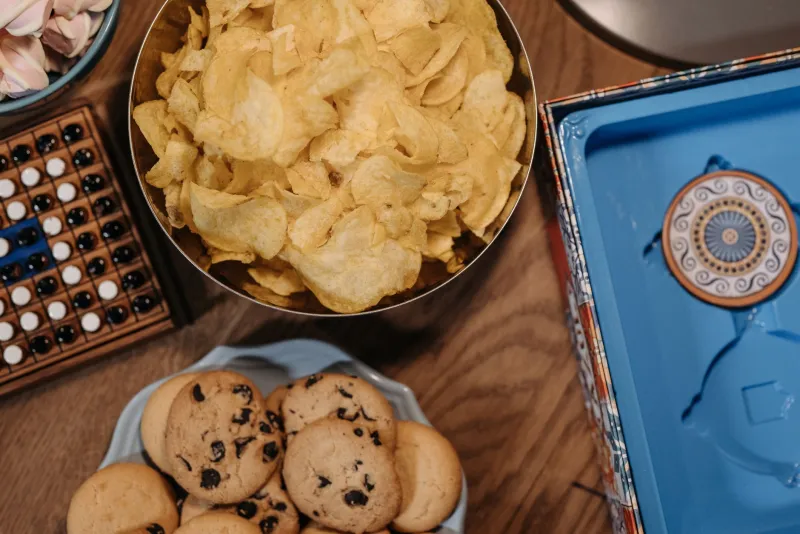
At half time, the chips arrive. This is non-negotiable. The kitchen does a roaring trade in bowls of chips and questionable garlic mayo, and for ten minutes the quiz pauses while people argue about whether the chips are better than last week. They are. They always are. The pub has quietly worked out that a quiz without chips is just homework with beer.
Then comes the tie-breaker. Alan has a folder of them, handwritten, going back years. The tie-breaker is always about trains. Nobody knows why. It might be a question about a station that closed in 1964, or a platform number, or the name of a train that used to run from somewhere to somewhere else. The teams that are not in the tie-breaker still lean in. The teams that are in it pretend not to care. Alan reads the question with the gravity of a man announcing a reshuffle. Someone wins. Someone loses. The chips are finished. The evening exhales.
A Quiet Anchor in the Week
Here is the thing about a weekly quiz: it is not really about trivia. It is a fixed point. On a Tuesday in November, when the nights are long and the town feels like it is holding its breath until spring, forty people get out of the house and sit in a room together. They do not have to be best friends. They just have to be there. The quiz does the rest.
In 2026, when so much of our social life has been outsourced to group chats and cancellations, the pub quiz remains stubbornly analogue. You cannot scroll it. You cannot mute it. You have to turn up, write your answers in biro, and accept that the team next to you will beat you on the picture round because one of them used to work in a museum. That is the deal. It is a good deal.
How to Do Your Own Local Quiz Properly in 2026
If you are thinking of starting a quiz — in a pub, a church hall, a community centre, anywhere with a kettle and a bit of floor space — here is a short, honest guide.
- Keep the rounds short. Four rounds of ten is plenty. Nobody needs a marathon. The point is the room, not the endurance.
- Write questions people can argue about. A question everyone knows is fine. A question everyone nearly knows is better.
- Have a half-time. Call it chips, call it a break, call it whatever you like. People need twenty minutes to gossip and buy another drink.
- Do not take the tie-breaker too seriously. But do make it a recurring joke. Ours is trains. Yours can be anything. The sillier the better.
- Let the wrong answers be part of the show. Read a few out. Laugh. Move on. A quiz that cannot laugh at itself is a quiz that will not last until February.
Alan will be back next Tuesday. The bulldog clip will be back. The chips will be slightly better than last week. And somewhere around question six, someone will give a confident, entirely wrong answer about a river, and the room will feel, for a moment, exactly like a town should.