What the Viewing Room Knows: A Morning Among the Lot Numbers
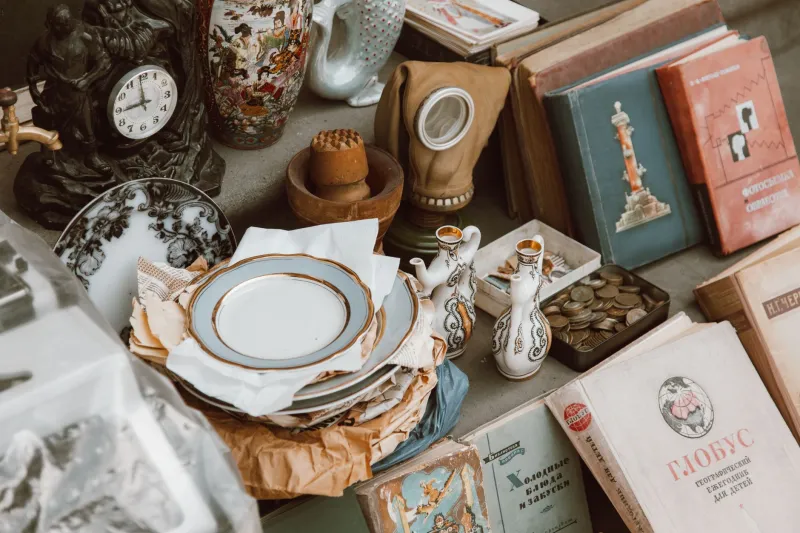
There is a particular smell to an auction viewing room. Not unpleasant, exactly — old carpet, furniture polish, a faint whiff of damp cardboard and the ghost of someone else’s front room. It is the smell of things being given one last chance to explain themselves before a man with a microphone decides their fate.
I went on a damp Tuesday morning in November, the sort of day that makes a village hall feel like a cathedral of other people’s clutter. The doors opened at nine. By ten past, there were already twelve of us circling the trestle tables like guests at a very odd wedding, trying not to make eye contact with the good stuff.
The ritual of the sign-in sheet
You give your name. You take a catalogue. You are handed a number on a small card, which you will almost certainly lose by the time the sale starts. Nobody asks why you are there. That is the first rule of viewing day: you could be a dealer, a collector, a nosy neighbour or a person who simply likes the idea of owning a boxed train set from 1978. The room does not judge. It just lets you wander.
The catalogue is the real guidebook. Forty-two pages of descriptions that sound like riddles: ‘A quantity of ceramics’, ‘A collection of brassware’, ‘A pine box containing assorted tools’. You learn quickly that ‘quantity’ means ‘we are not going through it’, and ‘assorted’ means ‘there is definitely a dead spider in there’.
Read the room, then the labels
There is an etiquette to this. You do not sprint to the lots you want. You drift. You start at the far end with the chipped teapots and the mismatched dinner plates, because everyone else is crowded round the railwayana and the oak dresser. The far end is where the honest stuff lives: a set of golf clubs with one missing iron, a lava lamp without a plug, three framed prints of ducks that have clearly been in a conservatory since 1994.
I picked up a teapot. Lid slightly loose. A hairline crack near the spout that the label described, with admirable optimism, as ‘wear consistent with age’. A woman next to me did the same, turned it upside down, tapped the base, and put it down with the expression of someone who has seen it all before. She did not say anything. She did not need to. The teapot had been judged.
Further along, a man in a fleece was inspecting a boxed Hornby set with the intensity of a bomb disposal expert. He held it to the light. He checked the corners. He ran a finger along the sellotape. Then he looked at the label, looked back at the box, and made a small noise in his throat. I have no idea what the noise meant. It might have been ‘yes’. It might have been ‘not today’. Either way, it felt like privileged information.
Dealer TV, without the cameras
Viewing day is the closest most of us will get to watching a nature documentary in real time. The dealers move differently. They have torches. They have magnifying glasses. One had a small wooden ruler, which he used to measure the height of a brass candlestick as if it were a matter of national security.
They also have a language. ‘All money’ means someone has overpaid. ‘A sleeper’ means a bargain nobody has spotted yet. ‘Trade’ means it is priced for people who intend to sell it on, not for people who intend to put it in the spare room. I heard a man say, ‘I’d want to see it out of the box,’ and another reply, ‘You and me both.’ That was the whole conversation. It was, somehow, enough.
The best part is the eavesdropping. Not because you understand it, but because you don’t. Two women spent five minutes discussing a set of epns spoons — electroplated nickel silver, apparently — with the gravity of diplomats. A man near the back muttered ‘that’s a nice little lot’ at a tray of costume jewellery, then wrote something in a notebook. I will never know what. That is the joy.
The brass thing nobody can name
Every auction viewing has one object that defies explanation. This time it was a brass object on a mahogany base, roughly the size of a small dog, with a handle on one side and a hinged lid on the other. The label said ‘A brass and mahogany desk accessory’. It was not a desk accessory. It was a mystery.
Three separate people picked it up. Each one turned it over. Each one looked at the base. Each one put it down without saying a word. It sat there all morning, radiating quiet shame. By the time I left, someone had put a bidder number next to it. I hope they know something I don’t. I hope it’s not a coffee grinder.
Why the wander matters more than the sale
The sale itself is next day. The gavel will fall, the numbers will be called, and most of this stuff will go home with someone new. But the viewing is where the town shows itself. It is where you see what people have kept, what they have given up, and what they think is worth a tenner. It is a museum of ordinary life, with everything labelled ‘sold as seen’.
I left without bidding. I usually do. But I had spent an hour in good company: the dealers, the nosy neighbours, the man with the ruler, the woman who knew a cracked teapot when she saw one. The smell of old carpets stayed with me all the way to the car. That, and the faint hope that whoever buys the brass thing finally works out what it’s for.
If you have never been to a viewing day, go. Take a torch. Take your time. Do not tap the teapots too hard. And if you see Lot 47 — a boxed train set with a slightly faded lid — leave it alone. I saw it first.