Leeks, Latchkeys and Low-Level Politics: A November Walk Round the Allotments
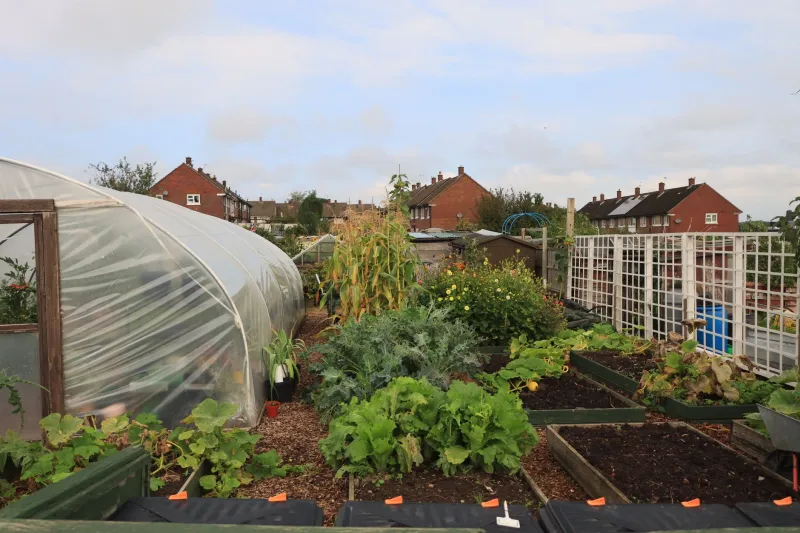
Every allotment site starts with the same sound: a latch dropping, then a metal gate swinging back on a hinge that has needed oiling since about 2011. After that comes the smell — wet leaf mould, a curl of bonfire smoke from three plots over, and someone's kettle doing its thing in a shed that has clearly been rebuilt more than once.
I spent the last fortnight wandering round allotment sites with no particular purpose beyond nosiness. Four of them, all within an hour of each other, none of them famous, all of them quietly doing the most useful civic work in the country. November is the right month for it. In July everyone's a gardener. By bonfire night the pretenders have thinned out and you can see the truth of a place.
First, the shed economy
Before you look at a single bed, look at the buildings. You can learn a lot about a site from how many of its sheds are held together with recycled fence panels and cheerful denial. One plot had a shed painted the exact orange of a 1978 caravan, with a hand-lettered sign reading PLEASE SHUT THE GATE — THE RABBIT IS NOT A PET. Another had no shed at all, just a folding chair, an upturned crate and a flask, which honestly felt like a flex.
Then there's the kit. Allotments run on a shadow economy of inherited tools: a spade with a shaft so worn it's moulded to someone else's grip, a hoe welded badly by a man who died before I was born, a watering can with a hole sealed by a square of bike inner tube. Nobody throws a tool away on a site. It gets passed on, re-handled, lent out, and eventually propped by a water butt with a note saying FREE IF YOU'LL USE IT.
That's not sentimentality. It's a functioning second-hand economy with no app, no fees and no reviews, and it works.
The scruffy half-row argument
Here's the thing I keep coming back to. A perfect plot tells you almost nothing. You can't read effort from tidiness — some of the most immaculate beds on any site belong to people who've been doing this for forty years and could grow a leek on a paving slab.
The plot that tells the story is the scruffy half-row: three beds dug and manured, four sorted, and then a stretch of couch grass and a polytunnel frame with no cover, quietly rusting into the landscape. That half-row is a document. It says a tenant got ill, or had a baby, or got a job that eats Saturdays. It says the site rep has decided to be kind about it this year rather than issue a letter. It says the waiting list is four years long and everyone knows it, so nobody's in a rush to boot anyone off over a bit of bindweed.
You can't get that from a survey. You get it from standing at a gate in the drizzle, looking at what people have and haven't managed.
The quiet politics of the cultivation clause
Every tenancy has a clause about keeping the plot cultivated. On paper it's simple. In practice it's the most delicate diplomacy in local government, conducted by volunteers with day jobs.
Who gets a plot is the first tangle. Waiting lists ballooned a few years ago and never really came down — the demand for a bit of ground hasn't faded, and in 2026 a plot is genuinely competitive in a way it wasn't a generation back. Some sites run first-come-first-served. Some go through the association. Some quietly prioritise the person who'll turn up in February, because a rep will always take a keen frost-bitten newcomer over an enthusiastic July applicant.
Who keeps a plot is the second tangle. A site rep has to decide, roughly annually, whether the half-dug row is a temporary wobble or a slow surrender. Too soft and the site fills with quarter-tended plots and a thousand small resentments. Too strict and you lose the bloke who's been there since 1998 because he had a bad winter. There is no correct answer, which is why every site answers it differently.
Honesty boxes and the trust index
My favourite civic indicator is the box by the gate. A biscuit tin, a cash box, an old cool box with a slit cut in the lid. Inside: a few quid, and outside: a glut of something.
In November it's leeks, cavolo nero, the last of the beetroot, bags of spuds with the soil still on. Prices are set at whatever feels fair — 50p a bag, a pound for a decent squash — and nobody's counting. You put your coin in, you take your veg, you go home and roast it.
If you want to know whether a town still trusts itself, don't read the crime statistics. Look at whether the honesty box has money in it at four o'clock on a wet Tuesday. On the sites I visited, it did. One had a note in it saying SORRY, ONLY HAD A TWENTY, CHANGE IN THE TIN NEXT WEEK — and, presumably, change in the tin the following week.
How to read a site in twenty minutes
If you're doing your own nosy walk, here's the short version. Start at the gate and check the noticeboard — the age of the notices tells you how active the association is. Look for water butts, because a site with good water capture has someone who thinks ahead. Count the sheds with kettles visible. Then look for the plots that are half-done rather than abandoned, because those are the ones that tell you how the site treats its people.
And if you're thinking about a plot yourself: go in winter, not spring. Anyone can fall in love with an allotment in June. Standing on a cold plot in November, looking at a hedge you'll have to cut and a path you'll have to clear, is the honest test — and it's the same test the whole site is quietly running on itself.
The scruffy half-row isn't a failure. It's a site being honest about the fact that growing food is a thing people do alongside the rest of their lives. I'd take that over a tidy brochure any day.