Standing at Stop C: The 11:12 That Tells You Everything
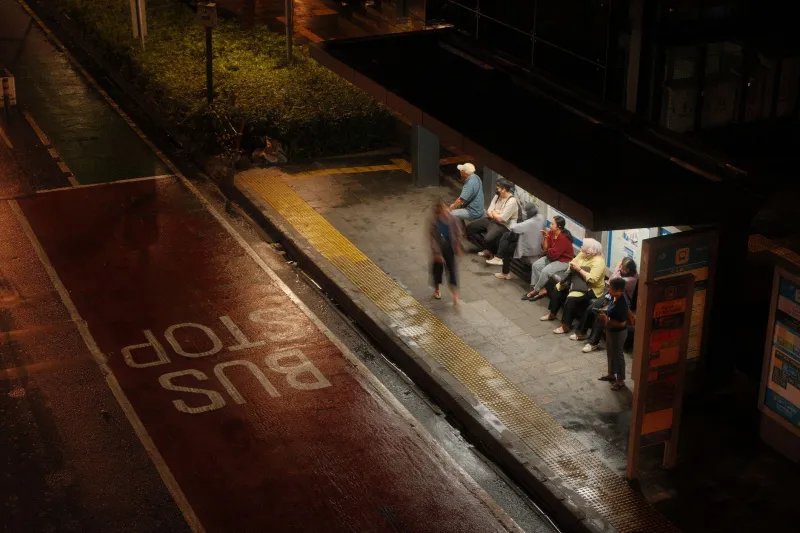
At 10.58 on a damp Friday, the bus shelter outside the Co-op is doing what it always does: holding six people, one folding chair and a faint smell of chips. The 47 is due at 11.12. Not the 11.12 to the city — the one that loops the estates and dumps you back by the retail park. It is the final service of the night, and for a certain slice of town, it is the difference between a night out and a night in.
Let us call it the 47. The number matters less than the timetable. Every town has one: the bus that leaves after the pubs have called time but before the taxi rank has turned into a scrum. Ride it once and you learn more about local nightlife than you would from a year of council press releases.
The shelter as a living room
There is a particular social order at a late stop. The smokers stand slightly apart, doing that dance of cupped hand and sideways step. Someone is eating a bag of crisps with the intensity of a person who has not had dinner. A woman in a supermarket tabard checks her phone, then the timetable, then her phone again. Nobody talks much, but everybody is listening for the same thing: the low rumble of a diesel engine that might, just might, be yours.
The bus shelter is also a small theatre of hope. When a car turns the corner, three heads lift. When it keeps going, three heads drop. By 11.10, the group has usually settled into a kind of resigned companionship. We are all going home. The only question is how much we are prepared to pay for it.
Who is actually on board
When the 47 finally arrives, it is half full. That surprises people who assume the last bus is empty. It is not empty. It is specific. There is a kitchen porter from the Thai place near the market, still smelling faintly of frying oil. Two lads in identical black jackets, arguing about whether one of them definitely locked his bike. A nurse who has missed the staff shuttle and is resigned to a forty-minute loop. A woman with a rolled-up yoga mat — not from a class, she explains, but from a friend's house where the wine went on longer than expected.
And there is the driver. Let us call him Kevin. He has been doing this route for eleven years, and he can tell you the exact minute the George and Dragon empties, the night the karaoke crowd gets rowdy, and the Sunday when nobody gets on at all. 'You can set your watch by the pub,' he says. 'But you can't set it by the town anymore. Some nights it's busy. Some nights it's me and a lad with a kebab.'
Kevin is not complaining. He is describing a map. The last bus is a moving census of who can still afford a night out, who still wants one, and who has given up because getting home is too much hassle. 'People don't stop going out because they've suddenly got boring,' he says. 'They stop because the last bus is at half ten and a taxi is eighteen quid.'
The driver knows the town's bedtime
There is a rhythm to the final service. The first stop after the pub is always the noisiest. The middle stretch is quiet — just the hum of the engine and the occasional ping of a phone. The last few stops are where the conversations get honest. A man in a fleece tells me he used to come into town every Friday. Now he comes once a month. 'It's not the beer,' he says. 'It's the rigmarole. You're watching the clock from nine o'clock onwards.'
That is the quiet truth of a town's nightlife in 2026. It is not just about whether there are bars open. It is about whether the whole evening hangs together: the bus in, the pint, the food, the bus home. Miss one link and the chain collapses. A town with a thriving high street but no late service is a town with a closing time built into its culture.
What the missing 11pm costs
When a town loses its final service, the effects are rarely dramatic. Nobody protests. The bus just stops appearing on the timetable, and people adjust. They go out earlier. They drink less. They drive — if they can — or they stay in. The taxi rank gets longer. The kebab shop gets quieter. The whole ecosystem shrinks by a few degrees.
You can see it in the passenger numbers. A bus that once carried twenty people at 11.15 now carries six. The operator says demand is low. The council says it is reviewing the network. The pub says it is a shame. And the six people on board say nothing, because they are the ones who still bother.
A practical check for 2026
The good news is that it is not all bad. Some towns have kept a late service, often by running it as a demand-responsive minibus or a community transport scheme. Others have night buses on Fridays and Saturdays only. A few have nothing after 10pm, which is worth knowing before you book a table for eight o'clock.
If you want to check your own town, do not rely on the poster at the stop — it may be three timetables out of date. Go to the operator's website and search for the route by name, not number. Look at the actual date selector. Then check the council's transport page, because sometimes the evening service is funded separately and does not appear in the main app. Traveline is still useful, but it is only as good as the data plugged into it.
And if you find a late service that works, use it. Not out of charity. Out of self-interest. A bus that carries six people is a bus that is easy to cut. A bus that carries twenty is a bus with a future.
The verdict from the back seat
At 11.47, the 47 pulls into the retail park and half the passengers get off. The nurse is first, walking briskly towards the hospital. The lads head for the cycle rack. The yoga mat woman disappears down a side street. Kevin checks his mirror, pulls away, and the bus is suddenly quiet.
I ask him what he thinks the last bus says about the town. He thinks for a moment. 'It says we're still here,' he says. 'But it also says we're tired.'
That feels about right. A town's nightlife is not measured only by how many people go out. It is measured by how many can get home. The last bus is not glamorous. It is not a headline. But it is the quiet infrastructure of a good night out — and when it goes, it takes a little bit of the town's evening with it.